
.png)

.png)
.png)
.png)


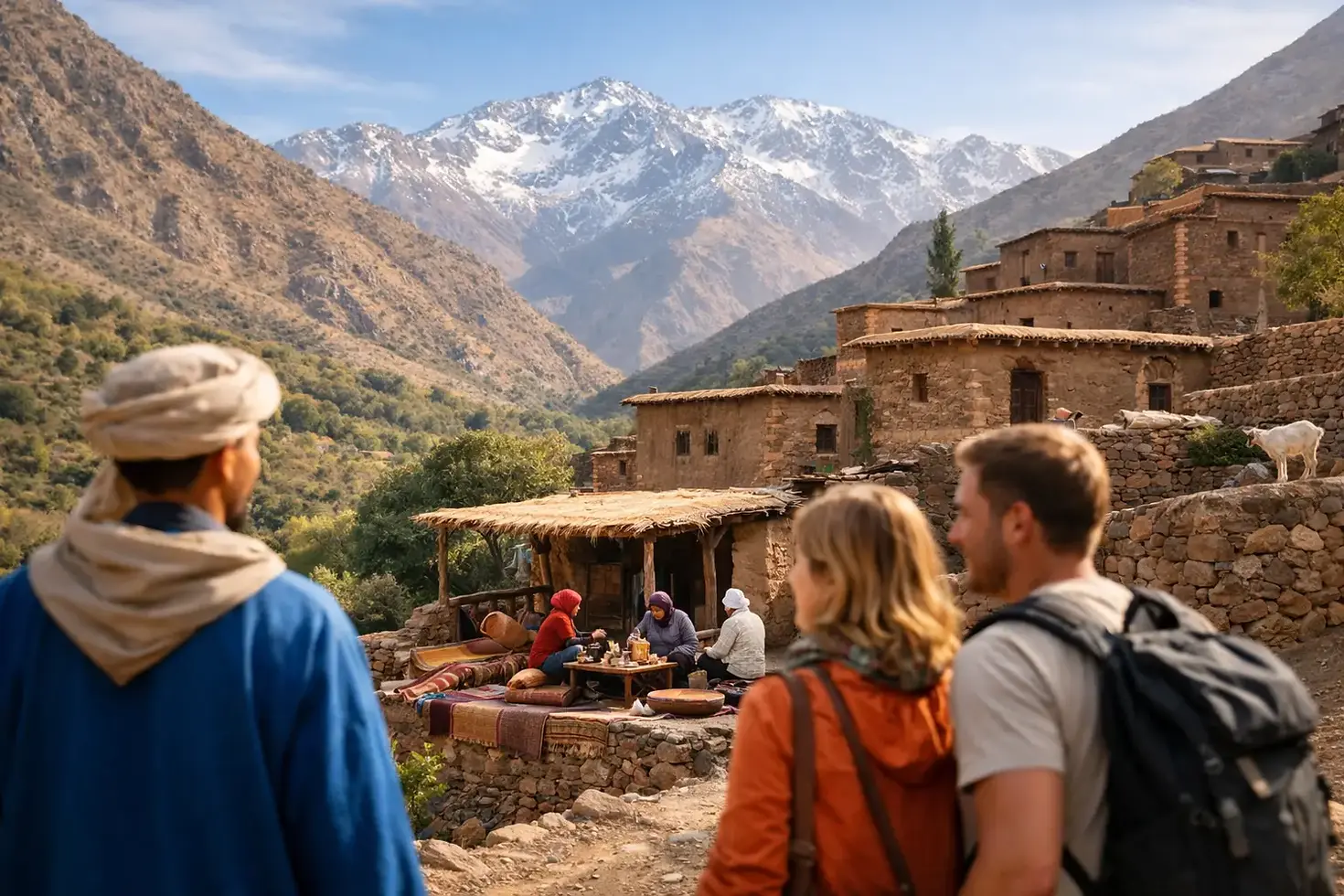
Atlas Village Stay Experience: What to Expect
The first thing most travelers notice in an Atlas village is not the view, though the views are excellent. It is the pace. Mornings begin with bread, tea, and movement on the paths before the day fully opens. An Atlas village stay experience is less about checking into a mountain hotel and more about stepping into a living place where daily routines, hospitality, and landscape are closely tied together.
For travelers planning Morocco beyond Marrakech or the desert, this kind of stay adds something that city riads and scenic drives cannot. It brings you closer to how mountain communities actually live, while still giving you a comfortable and memorable base for walking, relaxing, and understanding the region in a more grounded way. The right village, host, and route matter, so it helps to know what this experience really looks like before you build it into your trip.
What an Atlas village stay experience really feels like
In practical terms, most stays take place in a family-run guesthouse, a simple lodge, or a traditional home adapted for travelers. Rooms are often straightforward rather than polished in a luxury sense, but that simplicity is part of the appeal. Thick walls, handmade textiles, rooftop terraces, and meals prepared on site create a setting that feels personal rather than staged.
The days tend to follow the rhythm of the village and the mountain. You might wake to the sound of roosters, share fresh bread with olive oil and honey, then head out on foot with a local guide. In the afternoon, you return for mint tea, a tagine, and a slower stretch of time when the light changes across the valley. Even when the itinerary is light, the experience rarely feels empty. The setting itself does a lot of the work.
Travelers sometimes expect either a polished resort version of mountain life or a very rugged homestay. In reality, most Atlas stays sit somewhere in between. You can have comfort, hot meals, and organized logistics without losing the sense that you are in a real village rather than a purpose-built tourism zone.
Why travelers add village stays to a Morocco itinerary
An Atlas village stay works especially well for people who want contrast in a Morocco trip. After the intensity of Marrakech or Fez, the mountains offer space, quiet, and a different kind of connection. The appeal is not only the scenery. It is also the shift in perspective.
A village stay slows the trip down in a useful way. Instead of moving every night, you spend time in one place and notice more. You see how paths connect homes and terraces, how meals are shared, how children and elders move through the village, and how the mountain shapes everyday life. That sense of place is difficult to get from a day trip.
For couples, this can be one of the most memorable parts of Morocco because it feels intimate and unforced. For families, it offers a softer kind of adventure, with manageable walks, fresh food, and room to unplug. For friend groups, it pairs well with trekking, mule-supported hikes, or a few active days before heading south toward the Sahara.
Where the best Atlas village stay experiences happen
The High Atlas is the most common setting, especially valleys within reach of Marrakech. Imlil is the name many travelers know because it is the main gateway for Toubkal and surrounding trekking routes. It is convenient, scenic, and well set up for overnight stays. That said, it is not the only option, and it is not always the best fit if you want something quieter.
Villages in the Azzaden Valley, the Ourika Valley, or less-trafficked areas of the High Atlas can offer a stronger sense of calm and a more intimate atmosphere. Some are ideal for short walks and terraced landscapes. Others are better for full trekking days, mule support, and higher-altitude trails. The best choice depends on whether your priority is comfort, access, hiking, or cultural immersion.
This is where local trip design matters. Two villages may look similar in photos but offer very different experiences once you factor in road access, walking difficulty, accommodation standard, and how much tourism passes through. A well-matched stay feels easy. A poorly matched one can feel either too basic or too busy.
What the accommodation is actually like
Most village accommodations are warm and welcoming, but expectations should be set correctly. Luxury in the Atlas Mountains usually means thoughtful hosting, good bedding, clean bathrooms, beautiful views, and meals made with care. It does not always mean large suites, extensive facilities, or the kind of service model you would find in a high-end city hotel.
Heating can be limited in colder months, especially in winter at higher elevations. Wi-Fi may be present but inconsistent. Water pressure can vary. None of this is a problem for most travelers if it is communicated clearly in advance. In fact, many guests end up valuing the simplicity because it feels genuine rather than stripped-down.
The strongest stays tend to stand out for small things done well: a host who knows how to welcome international travelers, a terrace where you actually want to linger, a guide who adjusts the walk to your pace, and meals that feel home-cooked rather than standardized. Comfort in the mountains is often about care and preparation more than amenities.
Food, hospitality, and daily rhythm
Meals are a big part of the Atlas village stay experience. Breakfast is usually simple and generous, with bread, eggs, jam, olive oil, tea, and sometimes fresh fruit. Lunch may be packed for a walk or served on a terrace. Dinner often becomes the anchor of the evening, with soup, tagine, couscous, seasonal vegetables, and fruit.
Hospitality is direct and understated. Hosts are often busy running a household, receiving trekkers, preparing meals, and helping coordinate logistics at the same time. The warmth is real, but it is usually expressed through attentiveness and generosity rather than polished formality. That feels refreshing to many travelers, especially those looking for a more personal side of Morocco.
The pace of the day matters too. If you are used to tightly scheduled travel, the mountains can require a small adjustment. Things unfold more naturally. Tea takes time. Walks pause for views or conversation. Weather may shift the plan. Usually, that flexibility improves the experience rather than disrupting it.
How to plan an Atlas village stay well
The biggest planning question is how this stay fits into the rest of your route. For many travelers, one or two nights in the Atlas Mountains is ideal. It gives you time to arrive, settle in, walk, and enjoy the setting without making the trip feel too fragmented. If hiking is a central goal, you may want longer.
Transport is another key factor. Mountain roads, transfer times, and start points are manageable when coordinated properly, but they can become tiring if you try to improvise too much. Private transfers are often the best choice for travelers who want a smooth transition from Marrakech, the airport, or a multi-stop itinerary.
Guiding also makes a difference. Even on moderate walks, a local mountain guide adds context, route confidence, and flexibility. You are not just following a path. You are understanding the landscape, knowing when to stop, and moving at the right pace for your group.
If you are combining an Atlas stay with the Sahara, imperial cities, or coastal time, pacing is everything. The mountains are most rewarding when they are not squeezed into a rushed schedule. A carefully planned route helps each part of Morocco feel distinct instead of blurred together.
Is an Atlas village stay right for you?
Usually, yes, if you value place over polish and experience over spectacle. But it depends on your travel style. If you want spa facilities, nightlife, and extensive hotel services, a village stay may feel too quiet. If you are open to simpler comfort, scenic walking, and a more human scale of travel, it can be a highlight.
It is especially well suited to travelers who want Morocco to feel personal rather than packaged. That does not mean giving up ease. With the right support, logistics can be straightforward from beginning to end. At Nomadik Morocco, this is often where planning makes the biggest difference - matching travelers with the right valley, the right host, and the right pace so the experience feels natural rather than forced.
The best Atlas stays do not try too hard to impress you. They let the mountain, the village, and the hospitality speak for themselves. If you leave with a favorite meal, a few quiet trail memories, and the feeling that you saw a more grounded side of Morocco, the stay has done exactly what it should.


Comments