
.png)

.png)
.png)
.png)


Top Morocco Stargazing Experiences Worth Planning
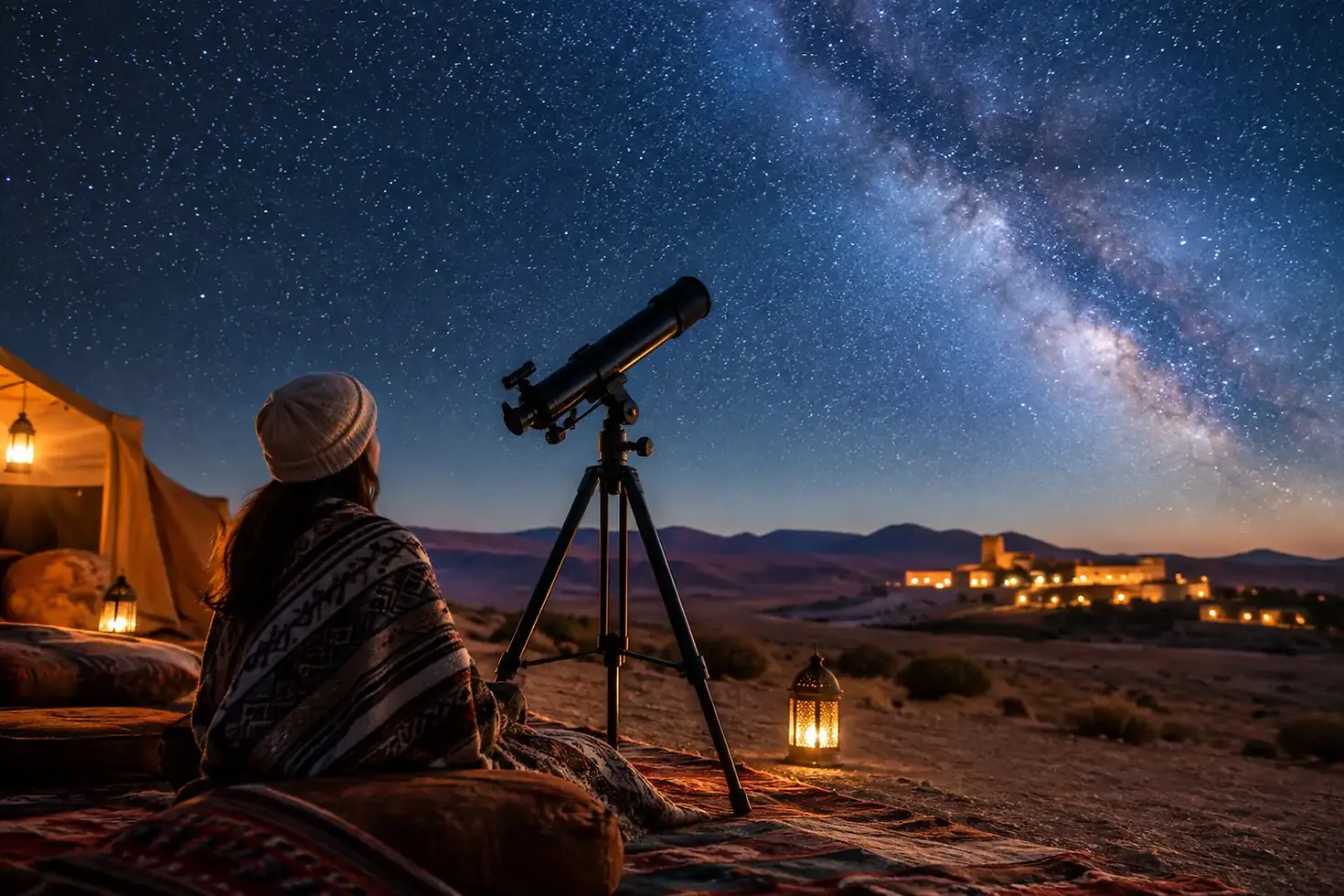
The top Morocco stargazing experiences begin after the last vehicle lights disappear and the desert cools quickly beneath your feet. Far from the glow of major cities, Morocco offers genuinely dark skies, a clear horizon, and the kind of quiet that makes even a short night outside feel memorable. For travelers already drawn to the Sahara or Atlas Mountains, stargazing is not a separate attraction to squeeze into the itinerary. It is one of the rewards of spending the night in the right place.
The best choice depends on your route, the season, and how much comfort you want after dark. A luxury desert camp near Erg Chebbi offers an easy first experience with a private tent and prepared dinner. A more remote journey toward Erg Chigaga provides deeper isolation and fewer travelers. Mountain stays bring a different setting altogether, with crisp air and stars framed by high ridges. Each can work beautifully when planned around realistic travel times and the lunar calendar.
Top Morocco Stargazing Experiences by Setting
Sleep beside the dunes of Erg Chebbi
Erg Chebbi, near Merzouga in southeastern Morocco, is the most accessible classic Sahara setting for many first-time visitors. Its tall, sculpted dunes create the desert image most travelers have in mind, and the open landscape gives the sky room to take over once night arrives. After sunset, the sand loses its daytime heat, camp lanterns become softer, and the Milky Way can be visible on clear, moonless nights.
This is a strong option for couples, families, and friend groups who want the desert experience without giving up comfort. Depending on the camp, you may have a private tent, proper bedding, a private bathroom, and a dinner served under the open sky. The trade-off is popularity. Merzouga has more camps and more activity than Morocco's most remote desert regions, so camp selection matters. A well-positioned camp away from busy routes gives you a quieter evening and a better view.
The journey is part of the experience. Most travelers reach Erg Chebbi as part of a multi-day route from Marrakesh or Fes, often with stops in the High Atlas, valley towns, and desert landscapes along the way. Rather than treating the night in camp as a quick add-on, allow time to arrive before sunset and settle in without rushing.
Go farther south to Erg Chigaga
For travelers who value distance, stillness, and a less developed desert landscape, Erg Chigaga is one of Morocco's most rewarding choices. Reached by four-wheel-drive from the M'Hamid area, these dunes sit farther from large towns and established tourist corridors. The final approach across tracks, dry plains, and sand is an adventure in itself.
Nights here feel more remote because they are. There are fewer lights on the horizon, fewer nearby camps, and a stronger sense that the desert continues well beyond the edge of your lantern. This makes Erg Chigaga especially appealing for repeat visitors, photographers, and small groups looking for a true wilderness atmosphere.
The trade-off is logistics. Reaching this area takes longer and requires careful routing, especially when fitting it into a week-long trip. Accommodations are generally simpler than at the most polished camps near Merzouga, although comfortable private camp options are available. Travelers who choose Erg Chigaga should do so because they want the remoteness, not because they are trying to see the desert in the shortest possible time.
Watch the sky from the Atlas Mountains
Morocco's dark-sky appeal is not limited to the Sahara. The High Atlas offers striking nighttime skies, particularly around quieter mountain villages and trekking routes. At higher elevations, the air can feel exceptionally clear, and the mountains create a dramatic silhouette beneath the stars.
An overnight stay before or after a Toubkal trek can be an excellent fit for active travelers. In places such as Imlil and more secluded villages higher in the valleys, the experience feels intimate rather than theatrical: a warm meal, cool mountain air, and a sky that looks close enough to touch. The best views are often a short walk from village lights, with a local guide who knows the terrain and ensures you return safely.
Mountain stargazing comes with a real comfort consideration. Even in warmer months, temperatures can drop sharply after sunset. During spring and fall, layers are essential; in winter, snow and cold can make an outdoor viewing session brief. The reward is a completely different perspective from the dunes, with sharp ridgelines, silence, and the occasional distant glow from a hillside home.
Add a quiet desert night near Zagora
The Zagora region can work well for travelers with limited time who still want a desert-style overnight stop from Marrakesh. The landscape here is more rocky and flat than the towering dunes of Erg Chebbi or Erg Chigaga, but its wide horizons can still deliver a beautiful sky. It is often easier to include in a shorter itinerary, particularly for travelers who prefer less driving.
Expect a different kind of visual experience. If enormous dunes are your priority, continue farther southeast. If your goal is a peaceful night outdoors, desert scenery, and an efficient route through southern Morocco, Zagora can be a sensible choice. The key is setting expectations correctly: stargazing can be excellent, but the setting is not the cinematic sea of sand found in the larger dune fields.
Choose Agafay for convenience, not total darkness
The Agafay stone desert outside Marrakesh is a practical option for travelers who have only one evening available. It offers desert-camp style dining, open views, and a quick escape from the city. For a special dinner and a look at the night sky, it can be enjoyable, especially as part of a luxury itinerary with limited time.
Still, Agafay is not Morocco's strongest choice for serious stargazing. It is closer to Marrakesh, with more ambient light and less of the deep isolation found in the Sahara or High Atlas. Choose it for convenience and atmosphere. Choose the Sahara when the night sky itself is a central reason for the trip.
When Morocco's Night Sky Looks Its Best
Clear skies are common in Morocco's dry regions, but the moon has as much influence on visibility as the weather. A new moon or the nights immediately around it are best for seeing the greatest number of stars and the Milky Way. A bright full moon, by contrast, lights the dunes beautifully and makes nighttime walking easier, but it washes out many fainter stars.
Spring and fall are often the most comfortable seasons for desert nights. Days are generally manageable, while evenings are cool enough to sit outside comfortably with a jacket. Summer can offer very clear skies, but desert heat may be intense before sunset. Winter nights can be spectacularly crisp and clear, though temperatures in the Sahara and mountains can fall close to freezing.
If stargazing is a priority, build your itinerary around the lunar cycle rather than simply hoping for a good night. A local trip designer can also recommend the right camp orientation, balance driving days, and make sure you arrive before darkness rather than after a long, tiring transfer.
What Makes a Stargazing Night Comfortable
The best night-sky experiences rarely require complicated equipment. Your eyes adjust to darkness over time, so avoid checking a bright phone screen every few minutes. A small flashlight with a red-light setting is useful around camp, and a warm layer is essential even after a hot desert day. Closed shoes help when walking over cooler sand or rocky ground after dark.
Photography is possible, but it is worth deciding whether you want to document the sky or simply enjoy it. Long-exposure images usually require a tripod, patience, and a camera that allows manual settings. Most travelers are happier taking a few simple photos, then putting the device away for the moment that cannot be reproduced on a screen.
Camp etiquette also matters. Keep voices low after dinner, use lights sparingly, and ask staff where to sit or walk away from the busiest area. In a small camp, these details protect the quiet that everyone came for.
Planning a Morocco Stargazing Journey
A three-day desert tour can introduce the Sahara, but it is often a fast-moving itinerary with substantial driving. Travelers who want a relaxed stargazing evening should consider four days or more, particularly from Marrakesh. This gives room for a sunset arrival, an unhurried night at camp, and a morning in the dunes before returning west.
For private trips, a customized route makes the biggest difference. A couple may prefer a refined camp at Erg Chebbi with a private dinner setup. A family may want shorter driving stretches and dependable amenities. Friends planning an active trip may combine a High Atlas trek with a remote desert night. Nomadik Morocco can shape the route, accommodation level, transport, and local support around the experience you want rather than forcing your trip into a fixed schedule.
When the sky is truly dark, Morocco has a way of making the journey slow down. Leave room in your itinerary for that hour after dinner, bring one extra warm layer, and let the destination do what it does best: turn a night in the desert or mountains into one of the clearest memories of the trip.


Comments